The Carbon Unit as a Scientifically Grounded Asset Value in the VCM – Study
OurOffset Nonprofit LLC
Date: 2025. 11. 24. Rev. 1.1
© Copyright 2013 – 2025 OurOffset Nonprofit LLC. – Service Description
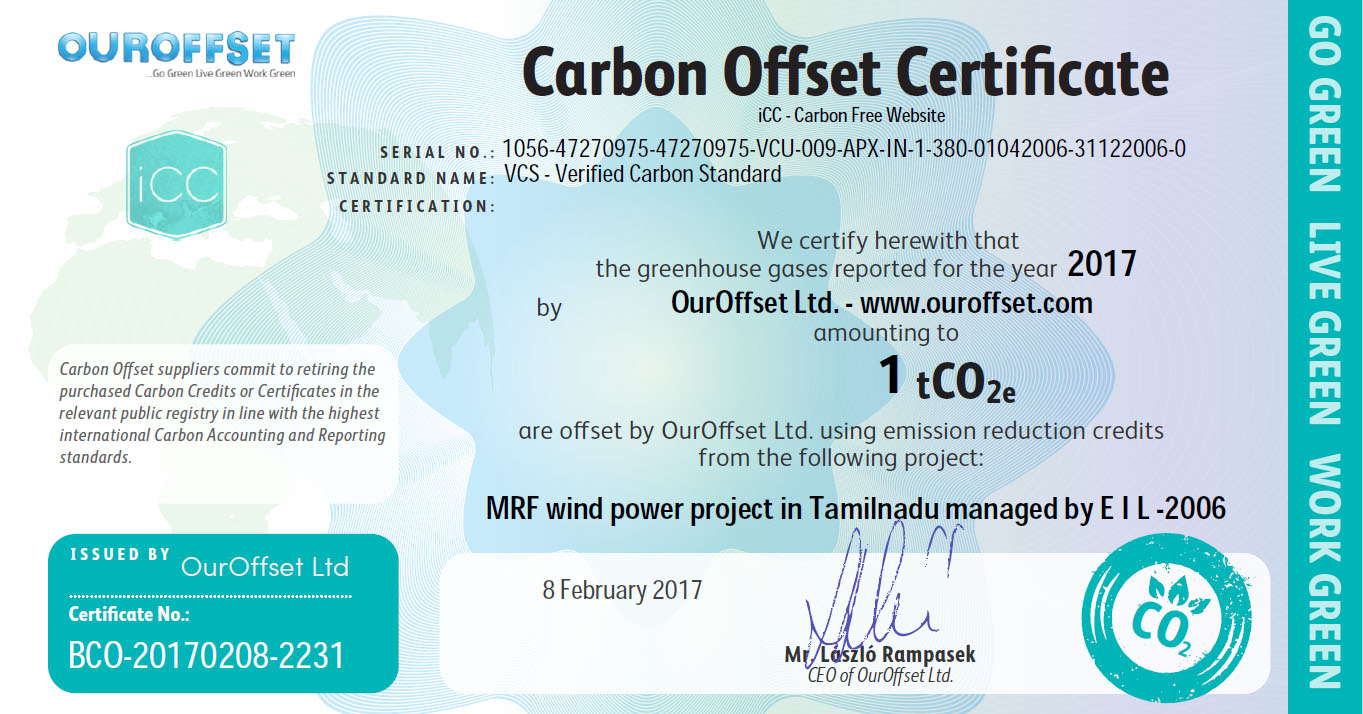
This page also introduces the carbon unit accreditation services of OurOffset Nonprofit LLC.
Permitted:
- ✅ Linking to this page
- ✅ Referencing the service
- ✅ Viewing the information
Prohibited:
- ❌ Copying the procedure and using it as your own service
- ❌ Reproducing the methodology for commercial purposes
- ❌ Transferring content to another website

1. Introduction
One of the most significant obstacles in managing the global climate crisis is that traditional economic systems do not price the climate and social damages caused by emitted greenhouse gases. However, modern climate science and climate economics have clearly demonstrated that increasing atmospheric greenhouse gas concentrations cause measurable, quantifiable, and financially interpretable damages. The question, therefore, is whether there exists a unified, standardized, auditable environmental asset unit capable of reliably expressing the true, scientifically proven impact of a realized climate action activity.
The project-based systems of the voluntary carbon market (VCM) are increasingly emerging in scientific and economic discourse as a platform capable of this function. The carbon unit, and the carbon credit certificate produced from it and authenticated by an independent auditor, is an integrated scientific-methodological-economic construct that represents the most rigorously controlled informational value indicator currently available for measuring climate protection performance.
This study examines and supports the theory that:
The carbon unit in the VCM is the world’s most precise, most rigorously audited, and most comprehensively grounded environmental value indicator, expressing the climate impact of a realized project in a scientifically, economically, and institutionally authenticated form.
2. Theoretical Background: The Carbon Unit and CO₂e as a Physical Basis
The foundation of the carbon unit is Carbon Dioxide Equivalent (CO₂e), which unifies the global warming potential (GWP) of various greenhouse gases (CH₄, N₂O, SF₆, HFCs, etc.) and normalizes them to CO₂. CO₂e is a:
- physical quantity, not an estimate,
- based on GWP timeframes (GWP20, GWP100) defined by the IPCC,
- accepted by the entire scientific community,
- calculable in a reproducible manner,
- measurable or modelable in a project-based context.
Thus, one tonne of CO₂e is a standardized metric that means the same anywhere in the world. This property enables the carbon unit to become a global climate correspondence measuring tool.
3. The VCM Methodological System: The Carbon Unit as an Auditable Impact Unit
The essence of the VCM is to generate carbon credits from real, measurable, avoided or removed emissions. The certificates thus created are based on a multi-level scientific and institutional framework:
3.1. Scientific Methodologies
Projects are based on natural science-based calculation frameworks such as:
- IPCC 2006/2019 methodologies,
- Soil carbon models,
- Biomass calculation protocols,
- Methane project leakage and gas flow models,
- Life cycle analyses (LCA),
- And other peer-reviewed scientific procedures.
These ensure that the carbon unit expresses a real climate process.
3.2. MRV System (Monitoring, Reporting, Verification)
Requirements for projects include:
- Obligation to continuously monitor emissions,
- Recording data in a standardized manner,
- Authenticating all data with an independent auditor.
This systematicity ensures that the carbon unit contains not an estimated, but a substantiated and validated impact.
3.3. Independent Auditing
Auditors examine according to standards:
- The methodology of carbon unit generation,
- Reproducibility of calculations,
- Actual data recording,
- The fact of project operation,
- Exclusion of double counting, compliance with ICVM CCP principles.
3.4. Registry Authentication Accreditation
In the VCM, the final and most crucial phase of creating a carbon unit is registry authentication accreditation, which is far more than a simple technical registration. This is the point where all previous project documents, calculations, and audited data converge in a unified system, and the authenticated carbon unit is officially created.
Accreditation is indispensable because the process does not culminate in the administrative act of entry. The registry phase includes:
- Finalizing the complete documentation of the MRV and the audit,
- Finalizing the independent auditor approval,
- In-depth verification of project data and the calculated impact,
- Creation of the carbon unit derived from real, verified emission reduction,
- And the accreditation of the full documentation, which officially recognizes the authenticity of the climate impact.
In this process, the registry is not a simple database, but an accreditation endpoint that:
- Authenticates the project’s full compliance,
- Guarantees the creation of a unique, non-duplicable carbon unit,
- And records the scientifically proven impact as a digital asset value.
The carbon unit comes into being with accreditation. This is the moment when the climate action impact — based on controlled and authenticated data — becomes a digital climate unit with asset value.
Only thereafter can the carbon credit certificate be produced from it, which carries and certifies the project’s proven climate impact.
The authenticated and accredited carbon unit:
- Receives a unique, irrevocable identifier,
- Is recorded in the registry in a public, transparent manner,
- Is based on controlled project data and audited MRV,
- And becomes one of the world’s most strictly authenticated digital environmental asset values.
Accordingly, the essential condition for the legally valid creation and registration of the carbon unit is the involvement of the registry. Any further exercise of economic or dispositive rights related to the carbon units shall be considered lawful only with the approval granted by the registry operator. The project owner cannot alienate, transfer, or sell the carbon units by bypassing the registry’s approval.
Revenue from the sale of carbon credits may only be used for the maintenance, operation of the project that created the carbon unit, and/or the implementation of new projects with demonstrably climate-positive impact. The registry — as the place of origin and authentication point of the carbon unit — is entitled and obliged to verify the existence and fulfillment of this obligation, and with its approval authority, to ensure that the use of the consideration complies with the project objectives and the requirements for authenticated climate impact.
The issuance of a carbon credit certificate falls solely within the competence of the registry or an organization delegated by it, based on the master certificate and approved documentation related to the project.
4. The Economic Meaning of the Carbon Unit: Monetizing Climate Damage
The asset value nature of the carbon unit is best understood by considering the latest climate economics research. The seminal study published by Bilal & Känzig (2023–2024) demonstrates:
- Global warming causes non-linearly increasing economic and social damage with each additional tonne of CO₂ emitted.
- These damages are measurable in GDP-level, macroeconomic losses.
- The real social cost “marginal social cost of carbon” falls in the range of 42–1500 USD/tCO₂e.
This can be interpreted as follows:
Emitting one tonne of CO₂e causes concrete, measurable, monetizable social damage.
The carbon credit precisely expresses that this damage has been avoided, and it documents this in a:
- physical,
- scientific,
- audited,
- registered
format.
Therefore, the carbon unit can be considered a real asset value, which in its content is the financial representation of an avoided future damage.
5. The Carbon Unit as the World’s Most Integrated Environmental Asset Value
The unique property of the carbon unit in the VCM is that it is simultaneously:
- a physical quantity (CO₂e),
- an impact verified by a scientific model,
- a data-based measurement result,
- an auditor-verified fact,
- a publicly recorded digital instrument,
- the monetized value of social damages,
- an informational asset with globally unified meaning.
There is no other environmental metric or authentication structure in the world that is to such an extent:
- standardized,
- auditable,
- traceable,
- comparable,
- and expressible in economic value.
This property makes the carbon unit — and especially the carbon credit — a foundational pillar of the global sustainable financial system.
6. Conclusion
The carbon unit — particularly in its validated and registered form on the voluntary carbon market — is one of the most important inventions of the modern economy and climate science. It simultaneously expresses:
- the avoided climate damage,
- the scientific verifiability,
- the auditor compliance,
- the digital asset value,
- and the real climate impact of human activity.
The carbon unit and the carbon credit certification/certificate created from it is humanity’s currently most reliable tool for transforming climate change mitigation into an objective, measurable financial value (asset value). The VCM structure ensures that this value is real, transparent, and independently verified — thereby making the carbon unit the world’s most strictly audited, most scientifically grounded, and most socially significant environmental asset value.
The carbon unit, the carbon credit, and the VCM market, with the aforementioned properties, form a universal system capable of connecting today’s capitalist economic-financial paradigm with the requirements of ecological sustainability and thereby able to provide real tools to the world’s governments, economies, companies, and individuals — that is, to everyone — for achieving the world’s decarbonization goals.
To our current knowledge, there is no other similar synergistic system, methodology, or mechanism that could advance and accomplish decarbonization and ecological objectives with comparable efficiency. THUS, ITS SIGNIFICANCE IS OF PARAMOUNT IMPORTANCE.