Genuine Carbon Removal or Another Risk in the Carbon Market?
The European Union’s Carbon Removals and Carbon Farming Regulation (CRCF) represents a significant attempt to establish a unified European framework for the certification of carbon removal and carbon sequestration.
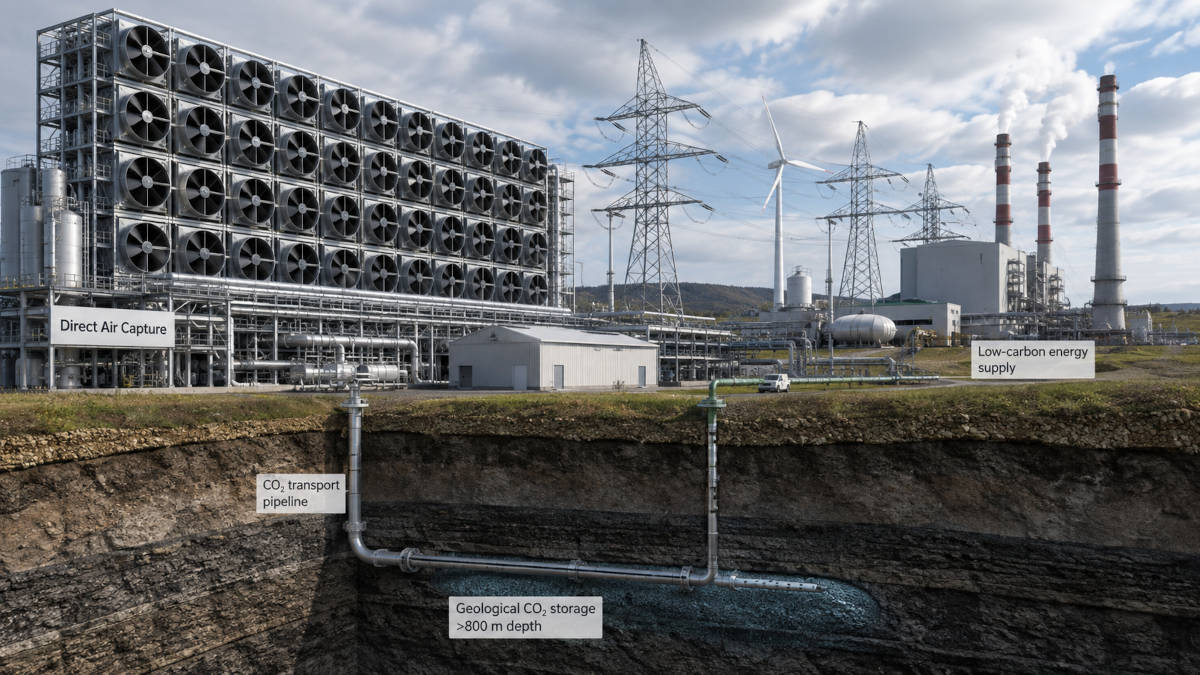
One of the regulation’s most important objectives is precisely to strengthen carbon market integrity and reduce the risk of greenwashing.
However, the question remains: can a certification system alone guarantee that the certified unit actually delivers the net climate impact attributed to it?
This is particularly crucial for the three technologies managed under the CRCF’s “permanent carbon removals” category: Direct Air Carbon Capture and Storage (DACCS), BioCCS, and biochar carbon removal (BCR). The European Commission adopted the first CRCF certification methodologies for these in February 2026 (.pdf) (https://climate.ec.europa.eu/news-other-reads/news/eu-sets-worlds-first-voluntary-standard-permanent-carbon-removals-2026-02-03_en).
Physics Cannot Be Circumvented by a Certificate
In the case of DACCS, the problem is particularly clear. The concentration of CO₂ in the atmosphere is extremely low; therefore, its separation from nitrogen, oxygen, and other atmospheric components is not a free thermodynamic process.
The second law of thermodynamics dictates an absolute minimum energy requirement for separating atmospheric CO₂. A 2026 scientific literature review gives this as approximately 0.43 GJ/tCO₂, or about 120 kWh/tCO₂, as the theoretical minimum. Current temperature-vacuum swing DAC systems have energy requirements several times higher, typically on the order of 5–10 GJ/tCO₂. (https://doi.org/10.1016/j.coche.2025.101219)
This is not merely engineering imperfection: the energy requirement derived from the second law of thermodynamics is a physical lower bound that the process cannot fall below. Engineering development can approach this limit but cannot eliminate it.
Therefore, for DACCS, the decisive question is not whether the equipment can extract CO₂ from the air, but rather, considering the total system’s energy consumption, life-cycle emissions, and other related impacts, what is the actual net CO₂ removal.
“Did we remove one tonne of CO₂?”
The correct question is: “How much net CO₂ did we remove from the atmosphere?”
If the energy required to operate the DAC process comes from a fossil source, a significant portion, or even all, of the apparent removal can be lost in the total system balance. Net removal is therefore not the same as the amount of CO₂ physically captured by the equipment.
BioCCS: A Different Path, Similar Accounting Problem
In the case of BioCCS, the CO₂ originates from biomass. As the biomass grows, the plant absorbs CO₂ via photosynthesis. Then, the biomass is used to produce energy or other products, while the resulting biogenic CO₂ is captured and stored in a geological formation.
On paper, this can result in negative emissions.
In practice, however, the question is far more complex:
where does the biomass come from, what would have happened to it without the project, what land-use changes does it cause, how much energy does the process require, what emissions occur throughout the entire supply chain, and is there truly an additional effect?
A detailed 2025 assessment by the Öko-Institut on the draft CRCF DACCS/BioCCS methodology concluded that despite improvements to the methodology, the risk remains that no actual net removal occurs, or that the system significantly overestimates the amount removed. The authors highlighted issues such as biomass additionality, total mass balance, and handling of uncertainties.
This is an extremely important warning.
In a carbon removal system, it is not sufficient to measure just one stage of the CO₂’s journey. The net outcome of the entire system must be verified.
Biochar: Not All Carbon is Permanently Removed from the Atmosphere
Similar questions arise in the case of biochar carbon removal.
The biochar produced via pyrolysis can indeed contain stable forms of carbon and, under suitable conditions, can store carbon for a long time. However, this does not automatically mean that every tonne of biochar produced is equivalent to one full tonne of permanent CO₂ removal.
The origin of the feedstock biomass, its alternative use, the energy demand of the pyrolysis process, process emissions, the actual stability of the biochar, and the conditions of its application in soil or other media all influence the net result.
According to the Öko-Institut’s 2025 assessment, even with improvements to the CRCF biochar methodology, the possibility remained that the methodology could lead to non-actual removal or a significant overestimation of removal.
Carbon Market Watch reached a similar conclusion in its comprehensive examination of the CRCF permanent removal methodologies, which specifically analyzed DACCS, BioCCS, and biochar systems.
The August 2025 analysis by Carbon Market Watch explicitly examined the CRCF methodologies for DACCS, BioCCS, and biochar, and identified, among other things:
- additionality shortcomings,
- biomass accounting problems,
- leakage risks,
- biochar monitoring and liability problems.
(.pdf)
The Problem is Therefore Not That These Technologies Are “Forbidden”
The debate is more important than that.
DACCS, BioCCS, and biochar are not problematic because they physically cannot work under any circumstances. The problem is that, due to physical and thermodynamic limits, the method used to calculate the actual net removal is of paramount importance.
A certificate does not change the laws of thermodynamics.
- It does not undo the energy consumption.
- It does not eliminate the system’s ancillary emissions.
- It does not, by itself, prove additionality.
- And it does not guarantee that the stored carbon will indeed remain outside the atmosphere for the specified timeframe.
The problem is not exclusive to permanent removal technologies. The Öko-Institut’s 2026 analysis, which examined the CRCF carbon farming methodologies, identified insufficient uncertainty management, leakage risks, additionality problems, and permanence deficiencies. According to the authors, these can create risks such that some CRCF units may not represent actual emission reductions or removals. (.pdf) (Öko-Institut e.V.)
What Does This All Mean for the Carbon Market?
The lesson is simple but fundamental:
it is not about certifying that a technology can handle CO₂, but rather that, as a result of the entire system, a specific quantity of net, additional, and adequately permanent climate impact has indeed been achieved.
This is particularly important for technologies that involve high energy demands, complex life cycles, or significant modeling uncertainties.
For OurOffset, therefore, the primary question of carbon market integrity is not the volume of issued credits, but the quality of the evidence behind the credit. The quantification of project results, independent verification, documentation, traceability, and the exclusion of double counting together create the foundation upon which a credible carbon market can be built.
The professional debate surrounding the CRCF precisely highlights this warning:
A carbon credit does not become real because a regulation issues a certificate for it. It becomes real if the climate impact behind it holds up physically, methodologically, and evidentially.
This is the standard that every carbon market system – whether a European regulatory framework or a voluntary carbon market Registry – must meet.
Sources and Professional Background
European Commission – CRCF permanent carbon removal methodologies
Öko-Institut – Assessment of draft methodologies under the EU CRCF
Öko-Institut – Revised methodologies under the EU CRCF continue to lack integrity
Carbon Market Watch – Faulty to the core
2026 scientific review – Kinetic and thermodynamic limitations in direct air capture